Your pharmacy may help
protect patients with VIVOTIF,
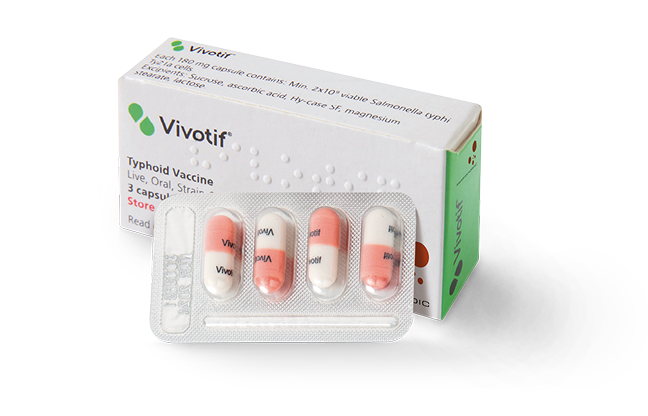
the only oral typhoid vaccine.1,2
Oral vs Injectable

Letting your patients know they have options for their typhoid vaccine administration allows them to request their
preferred method: oral (VIVOTIF) or injection.



VIVOTIF can be dispensed using your established workflow and is taken at home by the patient without injections or in-store administration. As the only oral typhoid vaccination, you can rely on VIVOTIF to deliver up to 5 years of typhoid protection.1,2*
1.4 million doses administered in clinical trials1
*Not all recipients of VIVOTIF will be fully protected against typhoid fever.
Vaccination can help prevent typhoid when food and water precautions are not enough.2
With a clear dosing schedule, text reminders, and a dose replacement program, we are dedicated to keeping your patients on the dose as you dispense.

Taken on Days 1, 3, 5, and 7, at least 1 week before their trip1

TAKE4 sends reminders on when to take VIVOTIF

Available to assist with storage/counseling issues5


The most common adverse reactions in clinical trials were abdominal pain (6.4%), nausea (5.8%), headache (4.8%), fever (3.3%), diarrhea (2.9%), vomiting (1.5%), and skin rash (1.0%).1 Please see full Prescribing Information for more details.
Sign up to get the latest on how VIVOTIF can help support
your pharmacy and your patients.
VIVOTIF is indicated for immunization of adults and children greater than 6 years of age against disease caused by Salmonella typhi.
Routine typhoid vaccination is not recommended in the United States of America. Selective immunization against typhoid fever is recommended for the following groups: 1) travelers to areas in which there is a recognized risk of exposure to S. typhi; 2) persons with intimate exposure (e.g., household contact) to an S. typhi carrier; and 3) microbiology laboratorians who work frequently with S. typhi. There is no evidence to support the use of typhoid vaccine to control common source outbreaks, disease following natural disasters, or in persons attending rural summer camps.
Not all recipients of VIVOTIF will be fully protected against typhoid fever. Vaccinated individuals should continue to take personal precautions against exposure to typhoid organisms. The vaccine will not afford protection against species of Salmonella other than Salmonella typhi or other bacteria that cause enteric disease. The vaccine is not suitable for treatment of acute infections with S. typhi.
VIVOTIF is contraindicated in patients with a hypersensitivity to any component of the vaccine or the enteric-coated capsule. The vaccine should not be administered to persons during an acute febrile illness. Safety of the vaccine has not been demonstrated in persons deficient in their ability to mount a humoral or cell-mediated immune response, due to either a congenital or acquired immunodeficient state including treatment with immunosuppressive or antimitotic drugs. The vaccine should not be administered to these persons regardless of benefits.
Acute Gastrointestinal Illness: VIVOTIF is not to be taken during an acute gastrointestinal illness.
Concomitant Administration With Sulfonamides and Antibiotics: The vaccine should not be administered to individuals receiving sulfonamides and antibiotics since these agents may be active against the vaccine strain and prevent a sufficient degree of multiplication to occur in order to induce a protective immune response.
Administration in Patients With Diarrhea or Vomiting: Vaccination should be postponed if persistent diarrhea or vomiting is occurring.
Need to Complete the Entire Vaccination Series of 4 Doses on the Correct Schedule: Unless a complete immunization schedule is followed, an optimum immune response may not be achieved. Not all recipients of VIVOTIF will be fully protected against typhoid fever.
Not All Recipients Will Be Protected — Need for Safety Vigilance: Not all recipients of VIVOTIF will be fully protected against typhoid fever. Vaccinated individuals should continue to take personal precautions against exposure to typhoid organisms (i.e., travelers should take all necessary precautions to avoid contact or ingestion of potentially contaminated food or water).
Concomitant Administration With Anti-malarial Drugs: Several anti-malaria drugs, such as mefloquine, chloroquine, and proguanil (approved in the United States as 1 of the 2 active ingredients in Malarone and its generic equivalents) possess anti-bacterial activity, which may interfere with the immunogenicity of VIVOTIF. A study in healthy adults showed that mefloquine and chloroquine can be administered together with VIVOTIF. Proguanil should be administered only if 10 days or more have elapsed since the final dose of VIVOTIF was ingested.
Pregnancy/Nursing: It is not known whether VIVOTIF can cause fetal harm when administered to pregnant women or can affect reproduction capacity. VIVOTIF should be given to a pregnant woman only if clearly needed. There are no data to warrant the use of this product in nursing mothers. It is not known if VIVOTIF is excreted in human milk.
In 2 trials conducting active surveillance for adverse reactions in persons receiving 3 doses (VIVOTIF recipients in the safety dataset, n=483), the most common adverse reactions were abdominal pain (6.4%), nausea (5.8%), headache (4.8%), fever (3.3%), diarrhea (2.9%), vomiting (1.5%), and skin rash (1.0%). Only the incidence of nausea occurred at a statistically higher frequency in the vaccinated group as compared to the placebo group. Reports to the manufacturer from early post-marketing clinical experience (1991-1995), during which time over 60 million doses (capsules) were administered, included all the adverse reactions identified above, as well as urticaria in the trunk and/or extremities (n=13), and 1 isolated, non-fatal case of anaphylactic shock considered to be an allergic reaction to the vaccine.
To report SUSPECTED ADVERSE REACTIONS, contact Bavarian Nordic at 1-844-4BAVARIAN or the US Department of Health and Human Services by either visiting www.vaers.hhs.gov/reportevent.html or calling 1-800-822-7967.
References:
VIVOTIF is indicated for immunization of adults and children greater than 6 years of age against disease caused by Salmonella typhi.
Routine typhoid vaccination is not recommended in the United States of America. Selective immunization against typhoid fever is recommended for the following groups: 1) travelers to areas in which there is a recognized risk of exposure to S. typhi; 2) persons with intimate exposure (e.g., household contact) to an S. typhi carrier; and 3) microbiology laboratorians who work frequently with S. typhi. There is no evidence to support the use of typhoid vaccine to control common source outbreaks, disease following natural disasters, or in persons attending rural summer camps.
Not all recipients of VIVOTIF will be fully protected against typhoid fever. Vaccinated individuals should continue to take personal precautions against exposure to typhoid organisms. The vaccine will not afford protection against species of Salmonella other than Salmonella typhi or other bacteria that cause enteric disease. The vaccine is not suitable for treatment of acute infections with S. typhi.
VIVOTIF is contraindicated in patients with a hypersensitivity to any component of the vaccine or the enteric-coated capsule. The vaccine should not be administered to persons during an acute febrile illness. Safety of the vaccine has not been demonstrated in persons deficient in their ability to mount a humoral or cell-mediated immune response, due to either a congenital or acquired immunodeficient state including treatment with immunosuppressive or antimitotic drugs. The vaccine should not be administered to these persons regardless of benefits.
Acute Gastrointestinal Illness: VIVOTIF is not to be taken during an acute gastrointestinal illness.
Concomitant Administration With Sulfonamides and Antibiotics: The vaccine should not be administered to individuals receiving sulfonamides and antibiotics since these agents may be active against the vaccine strain and prevent a sufficient degree of multiplication to occur in order to induce a protective immune response.
Administration in Patients With Diarrhea or Vomiting: Vaccination should be postponed if persistent diarrhea or vomiting is occurring.
Need to Complete the Entire Vaccination Series of 4 Doses on the Correct Schedule: Unless a complete immunization schedule is followed, an optimum immune response may not be achieved. Not all recipients of VIVOTIF will be fully protected against typhoid fever.
Not All Recipients Will Be Protected — Need for Safety Vigilance: Not all recipients of VIVOTIF will be fully protected against typhoid fever. Vaccinated individuals should continue to take personal precautions against exposure to typhoid organisms (i.e., travelers should take all necessary precautions to avoid contact or ingestion of potentially contaminated food or water).
Concomitant Administration With Anti-malarial Drugs: Several anti-malaria drugs, such as mefloquine, chloroquine, and proguanil (approved in the United States as 1 of the 2 active ingredients in Malarone and its generic equivalents) possess anti-bacterial activity, which may interfere with the immunogenicity of VIVOTIF. A study in healthy adults showed that mefloquine and chloroquine can be administered together with VIVOTIF. Proguanil should be administered only if 10 days or more have elapsed since the final dose of VIVOTIF was ingested.
Pregnancy/Nursing: : It is not known whether VIVOTIF can cause fetal harm when administered to pregnant women or can affect reproduction capacity. VIVOTIF should be given to a pregnant woman only if clearly needed. There are no data to warrant the use of this product in nursing mothers. It is not known if VIVOTIF is excreted in human milk.
In 2 trials conducting active surveillance for adverse reactions in persons receiving 3 doses (VIVOTIF recipients in the safety dataset, n=483), the most common adverse reactions were abdominal pain (6.4%), nausea (5.8%), headache (4.8%), fever (3.3%), diarrhea (2.9%), vomiting (1.5%), and skin rash (1.0%). Only the incidence of nausea occurred at a statistically higher frequency in the vaccinated group as compared to the placebo group. Reports to the manufacturer from early post-marketing clinical experience (1991-1995), during which time over 60 million doses (capsules) were administered, included all the adverse reactions identified above, as well as urticaria in the trunk and/or extremities (n=13), and 1 isolated, non-fatal case of anaphylactic shock considered to be an allergic reaction to the vaccine.
To report SUSPECTED ADVERSE REACTIONS, contact Bavarian Nordic at 1-844-4BAVARIAN or the US Department of Health and Human Services by either visiting www.vaers.hhs.gov/reportevent.html or calling 1-800-822-7967.